
The questions you ask every day
How long does a table stay occupied, and how many times does it turn?
Is the counter busier than the tables, and at what times?
It's raining tomorrow: how much should we prepare?
What is each cover worth?
What you measure with Kontrol Flow
Table turnover
Distinct customers and dwell time per table and per dining room.
Counter vs table
Dwell time and footfall at the counter compared with the tables.
Weather → what to prepare
Sales by weather condition, product mix by temperature and a 7-day forecast.
Covers and average ticket
From the till: covers, average ticket and best-selling products.
Pickup and drive-thru queues
Waiting times and queues in pickup and drive-thru areas.
Time slots
Breakfast, lunch, aperitivo: when people come in, and when they don't.
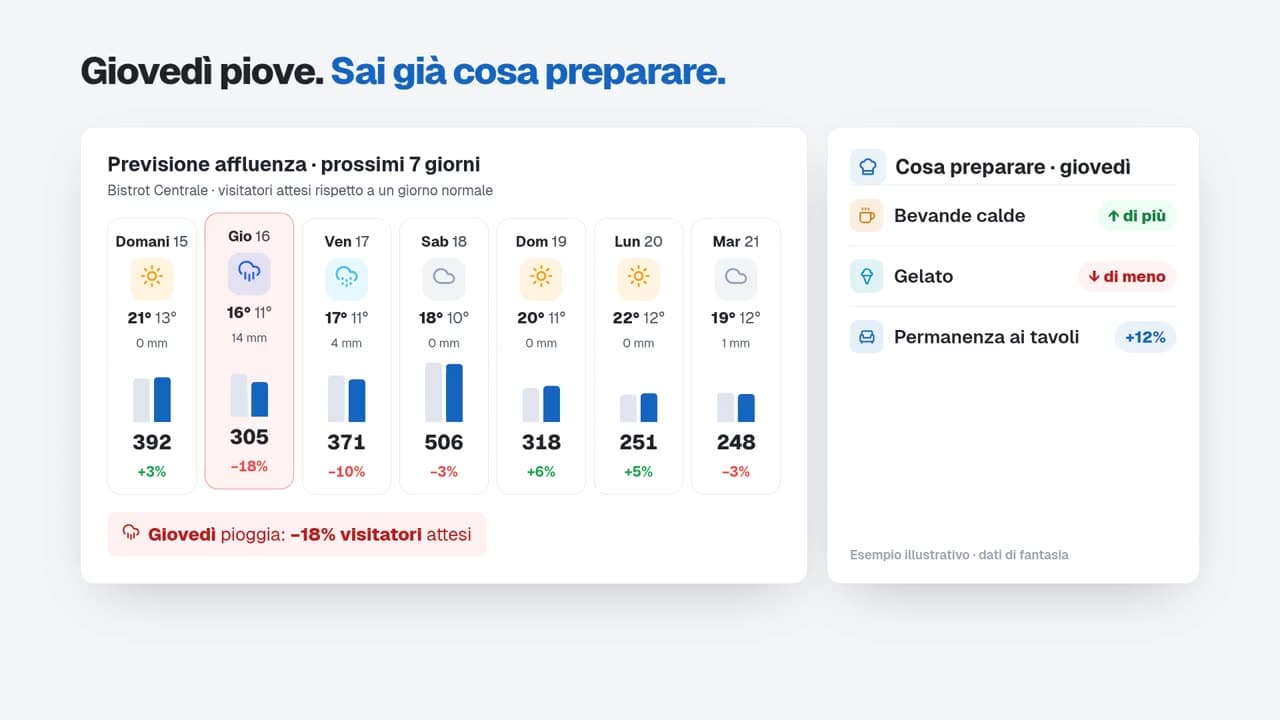
Rain is forecast for Thursday.
Kontrol Flow cross-references the forecast with your venue's history.
- Expected visitors
- −18%
- Time spent at tables
- +12%
- To prepare
- more hot items, less ice cream
Illustrative example.
Our origins
Kontrol Flow was born in the Ammu Cannoli stores in Milan: every metric was tested in the field before reaching your venue.
Related features
Go deeper into the metrics that matter most in your industry.
Heatmaps and zones
Movement heatmaps and dwell time by zone: average, median, P95 and engaged customers.
Queue and wait time
Average, median and P95 wait from waiting area to counter, queue, walk-outs and alerts.
How it works
No new installation. No changes to your infrastructure.
We connect the cameras you already have
Kontrol Flow reads the video streams from the IP cameras already installed in your store.
The analysis happens in the store
An NVIDIA edge device processes the images locally. Video never leaves the store.
You see the numbers
Real-time dashboards, an AI briefing every morning and alerts when something is out of the ordinary.
Privacy
We measure flows, not people.
Only anonymous, aggregated data
Numbers leave the store, not images.
No identification
Demographic data only in aggregate, optional, and enabled only after an assessment with your DPO.
Staff are not counted
Employees are automatically excluded from every number.
In-store processing, EU hosting
Images stay on site; aggregated data is hosted in Europe.
Frequently asked questions
Yes: you start with a single venue and the cameras already installed.
Yes, integration with your POS system (e.g. Quenta) or via API. During the pilot we can also start from an export of your POS data.
For each venue we cross-reference the 7-day forecast with your footfall and sales history.
We work with the IP cameras you already have installed. We check compatibility together on the first call.
No. Images are processed on site; only anonymous, aggregated data leaves the store.

AI-powered retail analytics that respects privacy. Transform your store's video feeds into actionable insights.

Stay Updated
Get the latest insights on retail analytics and AI.